How Long for Dead Coral to Gain Color Again
There's Withal Hope for the Great Barrier Reef
Fixing climate change isn't the merely thing we can practice to assistance the reef recover.
Digital Vision/Thinkstock
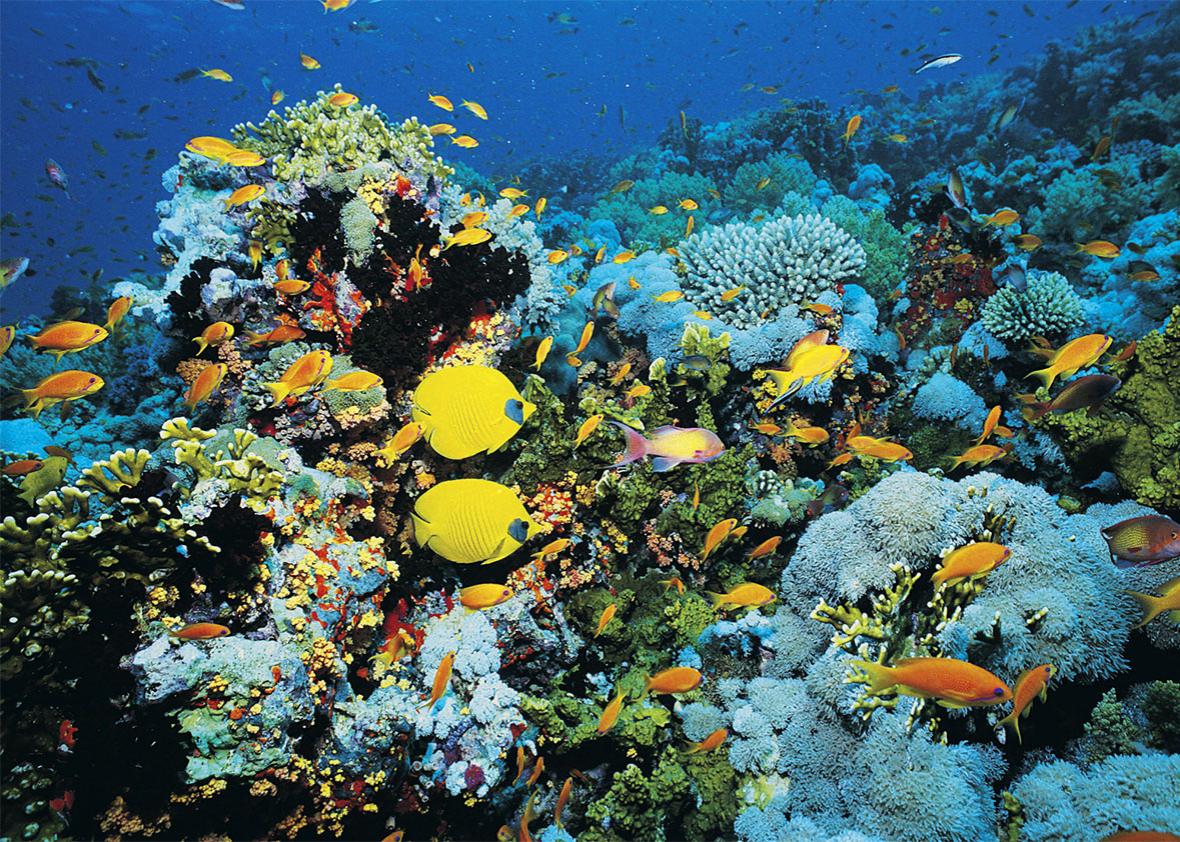
The Bully Barrier Reef is oftentimes vividly described, simply 1 describing word that doesn't make the cut is historic. And yet over thousands of years, untold billions of coral animals, like tiny structure workers, built the massive reef structure, now a 1,400-mile entity visible from infinite. Each anemone-similar coral (most less than an inch long) makes a tiny white calcium carbonate cup as information technology grows, and over millennia, the cups pile up like so many bricks as new corals build on the basic of their ancestors. The resulting reef structure, riveted with nooks and crannies, then serves as a platform for a vast diversity of foreign life forms that thrive in the humming coral reef—it is these life forms that supply the brilliant colour that normally dominates descriptions.
Coral researchers are now watching their field of study blanch white equally the Great Barrier Reef faces the largest bleaching event always observed. Their emotional entreaties have directed the world'southward focus toward the reef's plight—and while the problems are real, this has unintentionally generated misleading media coverage proclaiming that the reef is dead and dying.
Yes, this may be the worst bleaching event we've witnessed. In a survey of one-3rd of the system's three,000 private reefs, researchers report that 93 percent suffer from some caste of bleaching (along with reefs across the Indo-Pacific, some of which are simply entering their bleaching season). Climatic change is likely to arraign. So is all hope lost?
Not quite yet.
During the most recent reefwide bleaching events, in 1998 and 2002, bleaching affected at least half of the arrangement's reefs (fifty percent and 60 percent respectively). Yet in each case, only v percent of reefs suffered permanent damage. Expressionless coral at 150 reefs is not insubstantial, but in the finish, nearly all of the bleached coral recovered.
That's because bleached coral does not equal dead coral; it means very stressed out coral. The coral animals that build reefs rely on algae (called zooxanthellae) for energy. The algae alive inside coral tissues, giving colour to the otherwise transparent animals, and combine nutrients from their hosts with arable sunlight to make nutrient for them both. The algae tin can't survive long without its coral host, and coral can't survive long without the algae'south nutrient—some 80 pct of its total intake.
When water gets too warm, corals' algal partners stop functioning, churn out toxins, and begin to die. When that happens, the coral enters survival mode and kicks these malfunctioning partners out—if they didn't, they would dice, too. This is what we observe equally bleaching. The coral and so waits patiently for conditions to amend so that new, healthy algal partners tin can discover them.
It's horrible to sentry fields of coral plow white, equally their usually colorful bodies turn transparent and reveal the white reef below. Merely this is an adaptive strategy. Information technology gives corals a chance to survive naturally occurring oestrus waves. If they can persist long enough for the water to cool downwards, corals then concenter new algae partners and, given time, become dorsum to business equally usual.
The problem is that nether climate change, the rut waves are more frequent and severe—even though ocean temperature has only increased modestly. "It'south not very much, merely it'south a big deal for coral reefs," says coral microbiologist Michael Lesser from the Academy of New Hampshire, noting that the corals are as well bleaching more than frequently.
This is bad, considering recovering from bleaching, like recovering from disease, takes time. After the 1998 bleaching consequence on the Great Barrier Reef, almost bleached corals that recruited new algae partners within six months survived. But it took years before they grew and reproduced normally. If, in that time, they got hitting with some other wave of bleaching, recovery would take even longer—if they recovered at all.
The danger is that, in the face of frequent bleaching, corals won't exist healthy enough to survive the constant onslaught. Indeed, the ongoing bleaching outcome has killed nearly one-half the coral on some northern reefs within the Great Barrier Reef. Extremely high temperatures can even kill corals on the spot. "Corals virtually cook in front of you," says Lesser, as the coral cells and algae cells self-destruct simultaneously.
That sounds really bad—and it is—but even melted, dead reefs can recover. During the 1998 bleaching outcome, upward to 90 percent of corals on Western Australia's isolated Scott Reef died, and scientists expected recovery to take decades. For six years, it looked completely expressionless. Merely then, remarkably, coral larvae from faraway reefs arrived and by 2010, the reef had recovered to pre-bleaching conditions.
Notwithstanding, 12 years is a long fourth dimension to regroup—longer than most reefs will have as bleaching events get more frequent. If the temperature keeps going up, and it's predicted to, things offset to look pretty dire for the reefs (that is one of many reasons why reducing carbon emissions is important). But there are other ways to help corals—a study on the decline of Caribbean coral reefs provides clues.
Two years ago, the United States Geological Survey published a massive analysis of Caribbean coral reefs, featuring data from 35,000 reef surveys betwixt 1980 and 2012. They establish that overfishing and coastal pollution injure reefs more than climatic change did. So, while climatic change is certainly a problem, it'south non the main killer, yet. Humans exercise enough of other terrible stuff, also.
"If you could moving ridge your magic wand and brand climate change disappear tomorrow, in that location wouldn't exist whatever coral reefs in 50 or 60 years because of overfishing and coastal pollution and all the other horrible stuff that we're doing on regional scales," says coral biologist Jeremy Jackson, a co-author of the report. (Disclosure: Jackson is married to my former dominate, coral biologist Nancy Knowlton.)
This doesn't mean that climatic change isn't an issue for reefs—far from information technology. Rising temperatures and bounding main acidification (the other trouble carbon dioxide is causing) injure corals more if they're already stressed out from pollution and overfishing.
In order to give the reefs their best shot, we tin focus right now on reducing all the other stressors that are currently hurting them—including pollution and overfishing, which can both be reduced more immediately than climate change can be addressed. This could buy fourth dimension while politicians get it together on the other stuff.
Pollution especially is a problem on the Great Barrier Reef. Runoff from country carries sediment (which blocks light and reduces coral growth) and nutrients (which encourage seaweed to overgrow corals) into the body of water. Excess nutrients as well cause population explosions of a major coral predator: crown-of-thorns starfish, which crawl beyond the reef slurping corals from their skeletal cups. A contempo study plant that these starfish's consumption was responsible for nigh half of recent coral loss on the reef—compared with x percent from bleaching.
Reducing pollution is no small feat, only it's doable—it'south been done throughout the globe—and importantly doesn't require commitment from world leaders. Most pollution in the Nifty Bulwark Reef comes from two sources: sediment carried from ranches, and fertilizers and pesticides carried from sugar cane, banana, and cotton wool farms. Those are addressable problems. In improver, planting trees and other vegetation inland captures fertilizer and sediment before information technology reaches the body of water.
The skilful news is that the Australian government knows pollution is a problem and has a plan to address it. The bad news is that, according to a study published final month, it isn't working. The government programme suggests that farmers use less fertilizer and that ranchers institute grasses and copse to concord soil in place. The trouble is that these are mere suggestions; participation is voluntary. The authors recommend that government officials create incentives for ranchers, farmers, and other landowners to follow these recommendations—and as a result, to accept improve care of the Great Bulwark Reef.
Once participation goes up, corals will yet demand time to recover from this current catastrophic upshot—and with climatic change continuing its tiresome pitter-patter, they need all the fourth dimension they can get. So it is of import to become moving now earlier life becomes even more stressful for corals. By addressing the bug we know how to fix, we could buy them plenty fourth dimension to take a shot at survival.
How Long for Dead Coral to Gain Color Again
Source: https://slate.com/technology/2016/05/heres-how-the-great-barrier-reef-could-still-recover.html
0 Response to "How Long for Dead Coral to Gain Color Again"
Post a Comment